Observation. Recognition. Scanning.
These are three concepts Search and Rescue members throughout Saskatchewan are taught during their initial training.
How can you, as a hiker, forager, remote worker, or stranded motorist, better understand what makes something stand out and be seen? Rescuers are not searching for you specifically. They are scanning for abnormalities, small clues that stack together and ultimately point to you.
Why are things seen?
A lone tree in a field. A pop of colour from a cluster of chanterelles. The morning sunrise shining through your window, reminding you it’s time to dust.
Why are some things so easy to see, while others seem to disappear into their surroundings?
Let’s look at how things move from passive viewing to active seeing and how that shift applies directly to survival situations. Below are 13 different reasons that cause something to stand out and be noticed.
Movement
The human eye is wired to detect motion first.
A single branch swaying differently than the rest draws attention.
If you can move safely, you increase your chances of being noticed.
Shape
We recognize familiar geometry instantly.
Straight lines and right angles rarely occur in nature.
Use deliberate shapes that don’t belong in the environment.
Shadow
Shadows create contrast and depth.
A raised object casting a long shadow in snow is more visible than something flat.
Elevation increases detection.
Silhouette
Contrast against background matters more than detail.
A person standing on a ridgeline is visible long before facial features are.
Think in outlines, not details.
These first four primarily apply to people, animals, and other living things.
I remember snorkeling in the Caribbean. Our guide would dive down and retrieve conch shells for us to examine. I was amazed as I couldn’t see anything on the ocean floor at all.
But once she showed me what a partially buried conch looked like under a dusting of sand, I suddenly saw them everywhere. The shape had always been there. I simply didn’t know what to look for.
That is the shift from passive viewing to active seeing. Once you know what to look for, you stop just looking — and start seeing.
Recognition changes everything
Spacing
Nature is irregular. Uniform spacing stands out.
Three objects evenly spaced in a field draw attention.
Deliberate patterns are easier to detect.
Scale
Signals must match the size of the search area.
What is obvious at 50 metres disappears at 500.
Build it bigger than you think.
Texture
Contrast between smooth and rough draws the eye.
A reflective tarp against bark texture stands out immediately.
Break up natural texture.
Spacing, scale and texture relate more to the physical properties of objects.
Have you ever noticed a grove of trees planted by hand? They are easy to identify because of the uniform spacing. Even at a distance, something feels “different.”
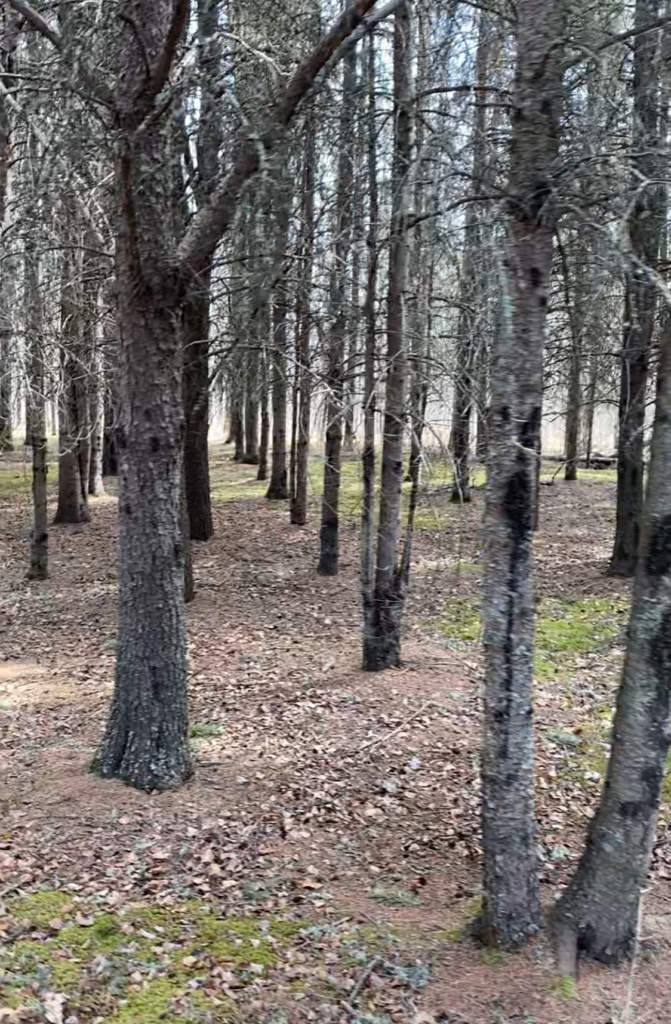
Position, colour, and shine are choices. They require intention. The same object can either disappear (become camouflaged) or demand attention depending on how it is placed and used.
Position
Things out of place get noticed.
A bright item high in a tree where it doesn’t belong attracts attention.
Where you put something matters as much as what it is.
Colour
Contrast beats brightness.
Orange in a green forest stands out. Orange in autumn foliage does not.
Choose colour based on background, not preference.
Shine
Both brilliance and reflectivity catch attention.
A mirror flash can be seen for miles under the right conditions.
Controlled shine is powerful — especially when it appears and disappears.
Colour is only effective when it disagrees with its surroundings.
Sometimes what alerts us to something isn’t visual at all.
Noise
Sound draws investigation when visual cues fail.
A whistle carries farther and clearer than shouting.
Intermittent sound attracts more attention than constant noise.
Smell
Search dogs operate on scent long before visual detection.
Smoke, food, or human scent can travel surprising distances.
Sometimes you are found before you are seen.
This past week, while hiking alone along a snow-covered summer road, I heard the rush of air through wings as a crow passed close overhead. I saw it only because I heard it first. Our other senses matter.
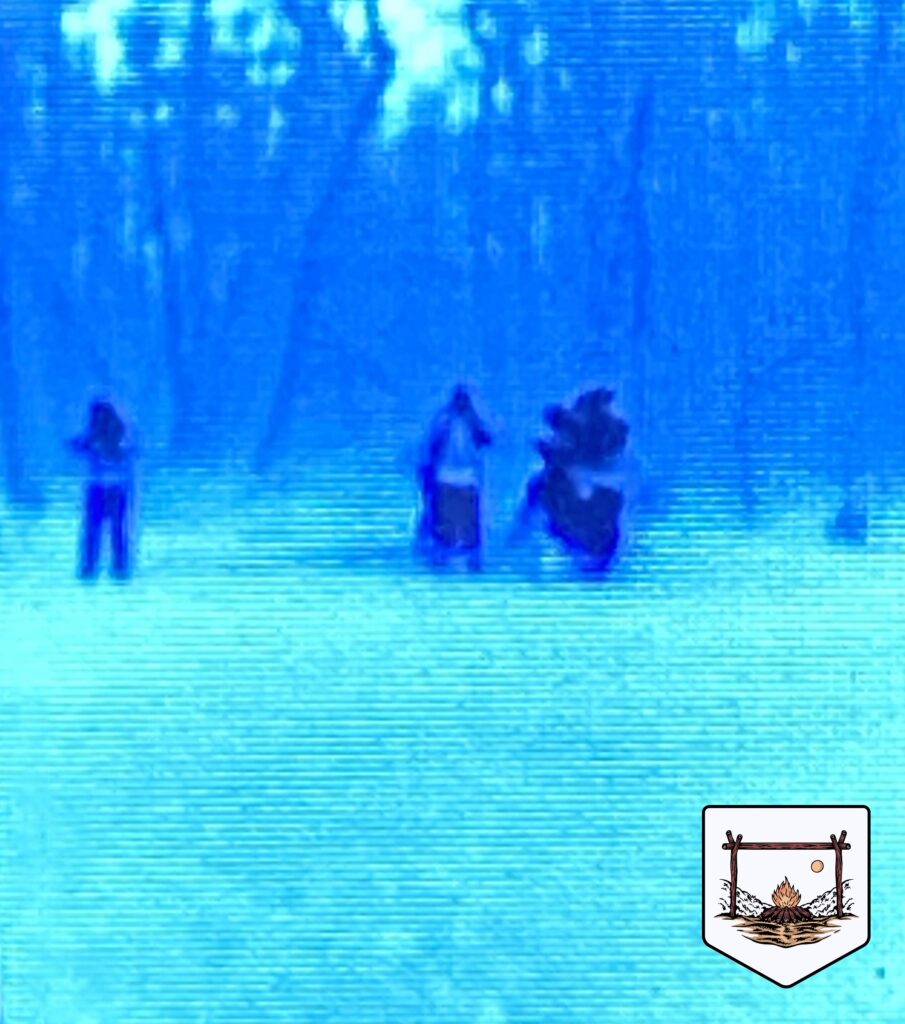
And increasingly, technology assists detection.
Temperature
Thermal imaging identifies heat differences.
A warm body against cold snow stands out dramatically.
Insulation, terrain, and overhead cover can reduce thermal signature.
Once you understand why things are seen, being noticed is no longer accidental. It becomes deliberate.
In a survival situation, that shift in thinking can make the difference between unintentional camouflage and becoming an eye magnet.
Visibility is rarely about luck. It is about contrast, abnormality, and intention. Next month, we’ll turn that understanding into practical signaling skills. Rescuers do not find people by chance; they find what stands out.