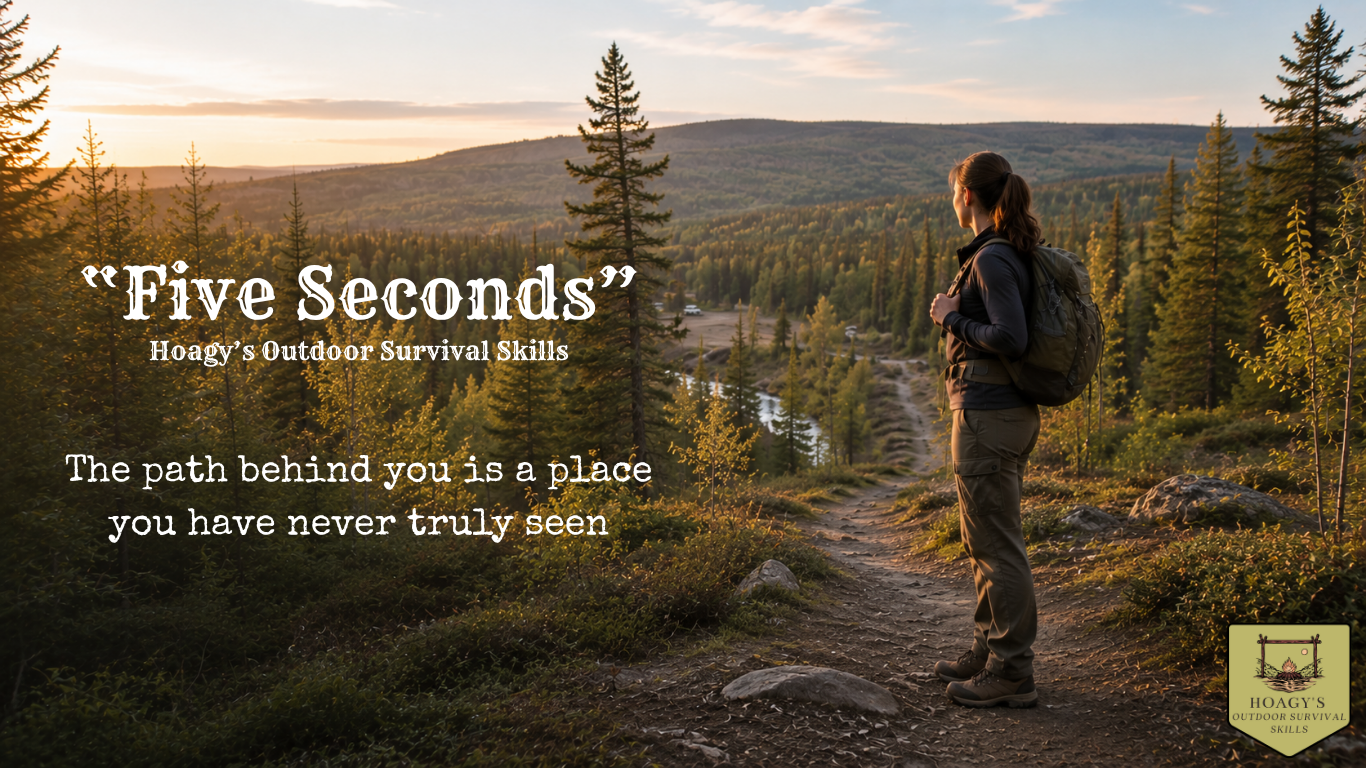
The path behind you is a place you have never truly seen.
Every year I teach people how to use a map and compass. Yet one of the best navigation habits I know takes only five seconds and requires absolutely no equipment.
When people travel, they naturally focus on where they are going, not where they have come from. This is often described as goal-directed attention. Your brain filters out information it doesn’t think is immediately useful. That is why we miss landmarks, side trails, and even our own vehicle.
The problem is only realized when we begin our return trip. Everything looks different.
You are now viewing different tree shapes, different shadows, different slopes, different skylines, and different lighting. Everything is being viewed from a new perspective.
Our brains are surprisingly poor at mentally rotating an environment 180 degrees. This isn’t really a survival problem; it’s a human perception problem.
When reviewing Search and Rescue (SAR) case studies, I often read statements like: “I knew exactly where I was until I turned around” or “I walked right past my trail.”
That happens constantly. The trail didn’t change; the person’s perspective did!
Experienced SAR members have developed a habit that newer members are still learning to build.
They stop, turn around and look back. It is part of a SAR members training. We called it the “Searchers Cube” In the field, searchers are expected to look up, down all around and behind them. If you ever have the opportunity to assist in a search, it’s possible you will hear this reminder being passed from team leads to their members.
Perspectives change and taking a small amount of time to absorb your surroundings in all directions will create a detailed mental map of what the return trip will look like.
Everything I’ve learned through Search and Rescue, navigation and outdoor survival points to one simple habit that anyone can learn, and for simplicity, I will just call it:
Five Seconds
Five Seconds is not a “Rule of Navigation”, it is simply something most experienced outdoors people learn naturally over time. It’s a proactive habit that develops a broader perception of your immediate environment. Everyone has 86,400 seconds each day to spend as they wish. I want to teach you how to spend some of those seconds to save yourself many more one day. I want to see you change that goal-oriented attention into wide-angle attention, what emergency services commonly calls Situational Awareness.
Five Seconds : Notice the bend in the trail.
Five Seconds : Notice the crooked spruce.
Five Seconds : Notice the angled side trail that intersected your route.
Five Seconds : Notice where your vehicle disappears from view.
Five Seconds : Notice the ridgeline.
Everyone can learn to do this.
Before you leave any place you may need to return to, stop for five seconds and look back. Observe what your return journey will actually look like, not what you think it will look like.
Walking away from your vehicle? Five Seconds
Stepping off trail to forage berries? Five Seconds
Leaving your canoe on shore? Five Seconds
Walking into a shopping mall you’ve never visited? Five Seconds
Turn around, and look. Often.
Gain a new perspective and fill in your mental map, because I promise you, the journey will not look the same when you come back.”
Goal directed attention gets you where you are going.
Wide angle attention, or situational awareness, tells you where you are and where you have been.
A beginner sees:
“I am walking on a trail.”
An experienced navigator sees:
“I am travelling along the north side of a shallow drainage, with a ridge rising to the west, a creek crossing ahead, and a large clearing behind me that will help me relocate this position on the return.”
Five Seconds is not about expensive gear or advanced navigation. It’s about building a tiny habit that costs nothing, takes almost no time, and can prevent a surprising number of navigation mistakes.
Those five seconds may save you hours later.